


Home Security · Data
| 5 Min Read | Updated June 2026 | The Adoorn Editorial Team |
Mail Theft, By The Numbers
How common is mail theft, and what thieves target most.
The Direct Answer
Mail theft is common enough to take seriously. In a federal audit of just five U.S. Postal Inspection Service divisions, the USPS Office of Inspector General counted 165,316 mail-theft complaints across fiscal years 2021 and 2022, and that is only five metro areas. Thieves target the highest-value mail first: checks, debit and credit cards, and tax and financial documents.1
| 01 | The Data |
How common is mail theft, really?
Here is the picture, without the panic. In a federal audit of five U.S. Postal Inspection Service divisions, Chicago, Houston, Los Angeles, New York, and Washington, DC, the USPS Office of Inspector General logged 165,316 mail-theft complaints across fiscal years 2021 and 2022, roughly 89% of all complaints those divisions received.1 That is five metro areas over two years. The national picture is larger.
The number matters less than what it tells you. Mail theft is common in pockets, and it clusters. If your neighborhood is showing a pattern: a NextDoor thread, a police alert, a neighbor who got hit, acting is the practical call.
| 02 | The Target List |
What mail do thieves target most?
It is not random. Thieves go for the mail that converts to money or identity fastest:
- Checks. Personal, payroll, government, or rebate checks; the easiest to “wash” and re-cash.
- Debit and credit cards. Newly issued or replacement cards mailed by your bank.
- Tax and financial documents. Refund checks, statements, anything with account numbers.
- Identity documents. Social Security mailings, replacement IDs, anything that opens a credit line.
The pattern is consistent: the highest-value mail you receive is the easiest kind to turn into someone else's money, which is exactly why locking that mail away takes your household off the easiest-target list.
| 03 | Who Is At Risk |
Who is most at risk for mail theft?
Risk tracks situation more than location. You are more exposed if your mailbox sits unlocked at the curb (the most reachable point on the property), if it sits full while you travel, or if you are receiving identity-sensitive mail in volume: tax season, a card reissue, college-admissions or financial-aid season. Areas with reported clusters carry elevated risk for everyone on the route, since mail theft is frequently coordinated rather than one-off. None of this requires alarm; it just tells you when and where a locked box earns its keep.

Adoorn · Free shipping · 30-day returns · Backed by warranty · Designed in Chicago · Ships fully assembled
| 04 | What To Do About It |
What to do about it.
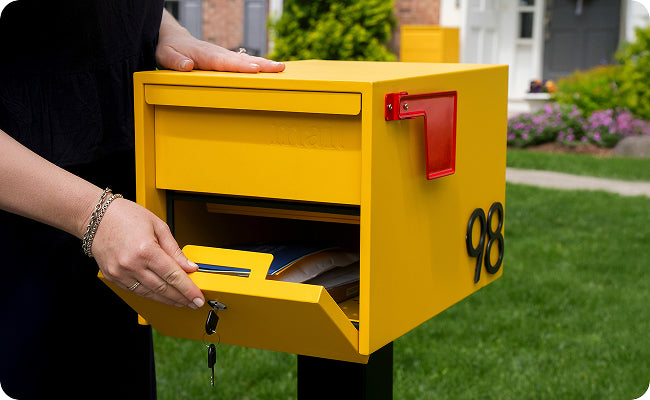
The data points to one practical takeaway: take your household off the easy-target list. A locking mailbox is the single most effective step, your mail drops through a secure slot and stays locked until you retrieve it. For the full picture, placement, habits, and the right mailbox for how your mail is delivered, the prevention guide walks through all of it, calmly and in order.
See The Mail Theft Prevention Guide →
Want a quick audit of your own front door? Get our Front-Door Security Checklist, one email, no clutter.
| 05 | The Questions |
Frequently asked.
How common is mail theft?
Common enough to act on calmly. A federal audit of five U.S. Postal Inspection Service divisions found 165,316 mail-theft complaints across fiscal years 2021 and 20221, about 89% of all complaints those divisions received, and that is only five metro areas. If your neighborhood shows a pattern, acting is practical.
What mail do thieves target most?
The highest-value mail: checks, newly issued debit and credit cards, tax and financial documents, and identity-sensitive mailings. These convert to money or identity fastest, which is why securing them matters most.
Is mail theft increasing?
Reporting and awareness have risen, and clusters appear wherever mail sits unsecured. Rather than chase a national trend line, watch your own area, a reported pattern nearby is the signal that matters for your household.
Who is most at risk?
Homes with an unlocked curbside mailbox, anyone whose box sits full during travel, and anyone receiving identity-sensitive mail in volume (tax season, card reissues, admissions season). Reported-cluster areas raise risk for everyone on the route.
How do I protect my mail?
The most effective single step is a locking mailbox, paired with collecting mail promptly. For the full prevention picture, see our mail theft prevention guide.
Related Resources
- If it already happened: How to report stolen mail, step by step
- Stop the next event: See locking mailboxes
- Prevent it: Mail theft prevention guide